Start with the shape of the building
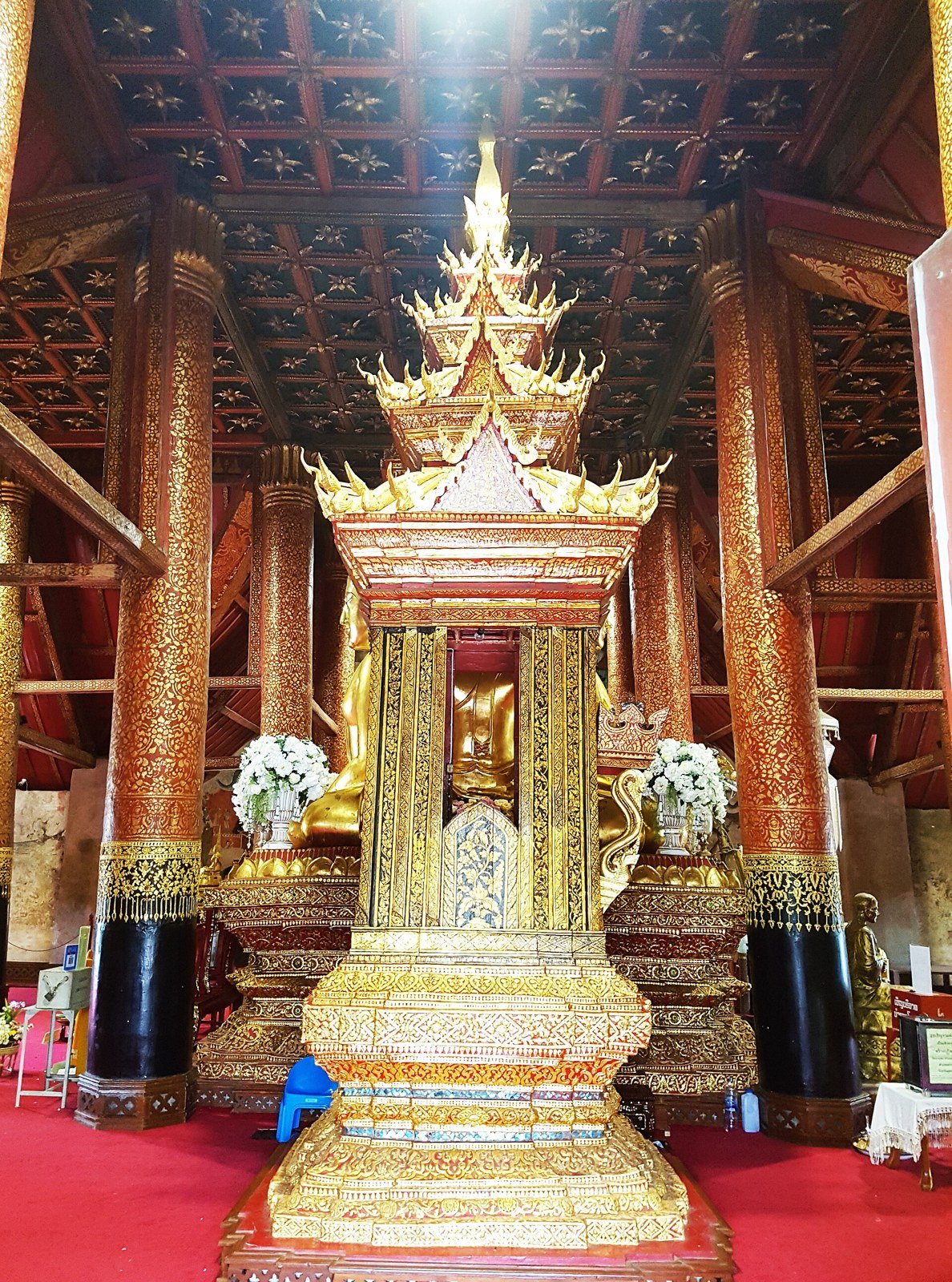
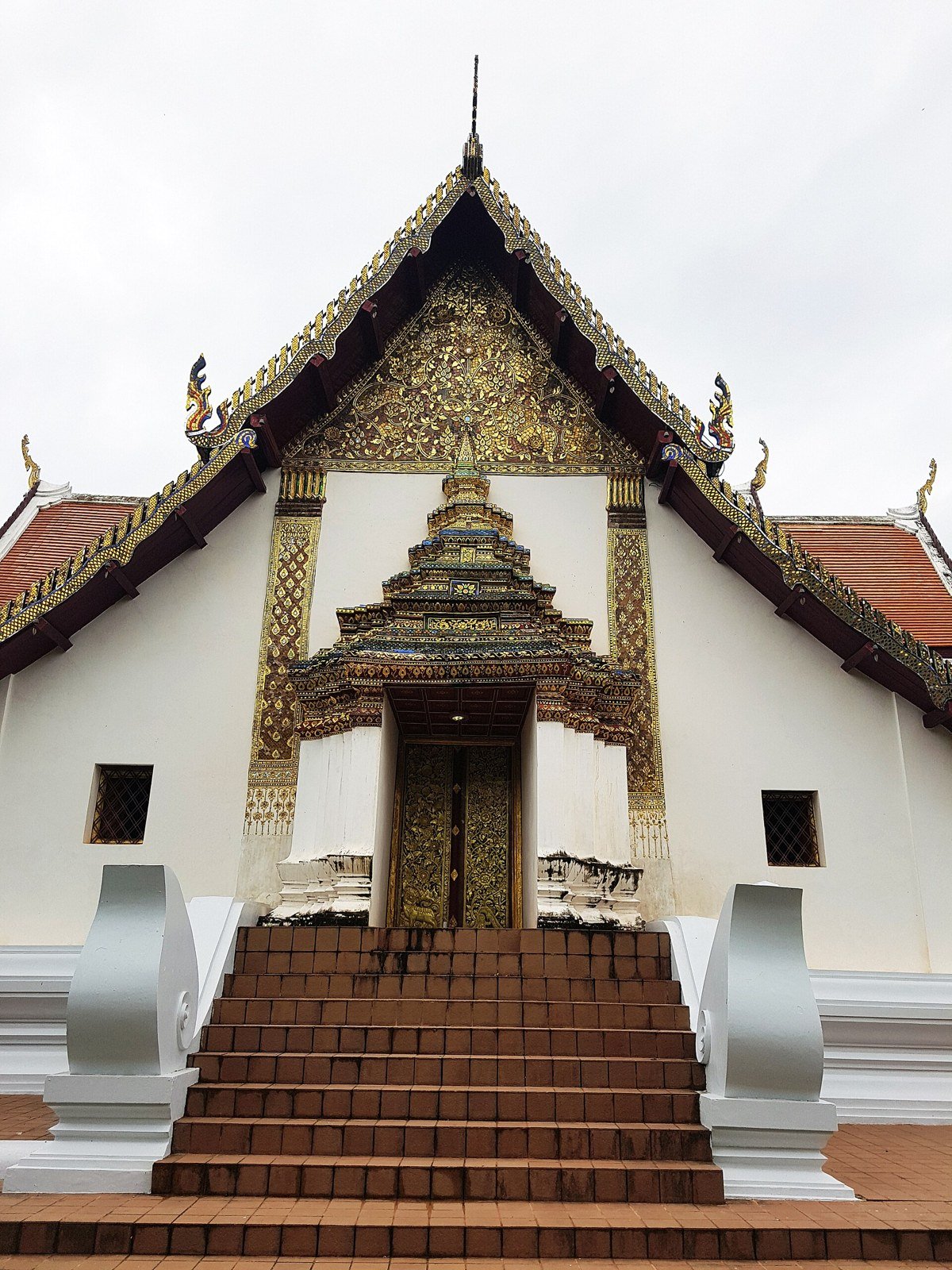
Nan’s provincial tourism office describes the ordination hall and assembly hall as combined in one building. Its cruciform form has porches facing four directions, with four large Buddha images positioned back to back. Looking at that arrangement first helps explain why the interior does not follow the single-fronted layout familiar from many other temples.
The office dates the temple to about 1596 and connects its former name with the ruler who founded it. It presents several interpretations of the four-image arrangement, rather than one universally settled explanation. You do not need to choose between those theories to appreciate how the four directions organise the space.
Find the couple, then follow the larger story
The Fine Arts Department dates the murals approximately to 1867–1874. Its account identifies three main subjects: the Khattana Kumara Jataka, the Nemi Jataka and episodes from the Buddha’s life. Clothing, buildings and figures also convey local ways of life, so the paintings offer more than an isolated romantic scene.
The department places the whispering man and woman beside a door on the western wall, with the Nemi story on the lower part of that wall. Use this as orientation if the visitor route permits, then give the adjoining scenes some attention. The familiar couple is not a complete explanation of the building’s religious imagery.
An editorial approach is to look once for the main narrative and a second time for a small detail such as clothing or a painted architectural feature. This gives a purpose to a longer visit without trying to identify every scene. Leave room for worshippers and other visitors rather than occupying one viewing position throughout.
Understand the dated flood assessment
Following flooding in August 2026, a government report dated 23 August quoted the Fine Arts Department’s inspection. It said the flood had not damaged the monument or the interior murals and described the visible cracks as pre-existing surface cracks. The same report discussed conservation planning related to differential settlement.
This is a dated conservation assessment, not a guarantee that every entrance or viewing area will be available on your visit. Follow any work barriers and the temple’s current circulation instructions. A close-up photograph of a crack, or an older flood headline, should not by itself be treated as proof that the whole temple is closed.
Put the mural visit inside the day
TAT’s Japanese information page publishes 06:00–18:00 for Wat Phumin and places it on Phakong Road in Nai Wiang. Arriving during the main part of the day gives more flexibility if access is interrupted by religious activity. Do not use evening activity outside the temple as evidence that the mural hall remains open.
Nan National Museum is another old-town cultural stop, but its own operating days must be considered separately. The museum’s official footer gives Wednesday–Sunday, 09:00–16:00, with Monday and Tuesday closure. Those are museum details, not Wat Phumin’s timetable. A Monday temple visit therefore does not automatically produce a matching museum itinerary.
Photograph with the artwork in mind
The surviving paintings are the attraction, not a backdrop to be leaned against. Keep hands and bags away from the walls, remove footwear wherever indicated and follow the current photography signs. Do not assume that flash, tripods or uninterrupted portrait photography are allowed because other people have cameras.
Anyone who needs step-free access should check the currently used entrance and the route into the hall. The historic four-sided plan does not establish that each entrance offers the same access. Interior viewing can still be the priority even if a group chooses a shorter visit with fewer changes of position.
Pair the old town with an east-bank outing
Wat Phumin and Wat Phra That Chae Haeng provide two different Nan temple experiences: murals in the town centre and a gilded stupa at a separate hill setting in Phu Phiang. It is reasonable to plan them on the same day with road transport for the Chae Haeng leg; it is not a continuous old-town walking loop.
A Nai Wiang hotel suits repeated visits to the central cultural area. Accommodation farther out can also work if you have transport, but assess the actual neighbourhood rather than choosing on the basis of “Nan” alone. If the paintings are your main interest, retain enough time for the hall and build the rest of the day around that visit instead of squeezing it between distant provincial excursions.
Sources & visiting information
Sources checked on 29 October 2026. The guide identifies limits or conflicting visiting details where they affect the plan.